
Open any supplement shelf and you will find a stack with eleven ingredients, three of which do the same job and two of which are present at doses too small to matter. That is how a bottle ends up costing $60 a month while delivering what a coffee and a decent night’s sleep would.
This guide ranks a few all-natural stacks differently. Each ingredient is graded on how strong the human evidence is, and each stack is checked for whether its parts do different jobs. It also covers how to run a trial long enough to see past the first-week novelty. If you want the wider background on this category first, the ultimate guide to nootropics for cognitive performance covers the individual compounds. This article is about putting them together sensibly.
Why most nootropic stacks are just expensive duplicates
Most commercial stacks are built for the label, not the brain. A longer ingredient list looks more impressive, so formulas collect compounds with overlapping effects. Three stimulants, two “calming” herbs, and a handful of extracts with a single small study behind each is a common pattern.

Duplication causes two problems. First, you pay several times for one effect. Second, you cannot tell what is working, because everything started on the same day. If you feel sharper, you do not know which capsule did it. If you feel wired, you do not know which one to drop.
A well-built stack gives each ingredient one job, and the jobs differ:
- Energy supply: helping brain cells keep up with demand.
- Alertness: raising how awake you feel right now.
- Smoothing: taking the edge off alertness so it does not tip into jitters.
- Stress buffering: lowering how strongly stress interferes with thinking.
- Structure and maintenance: supplying raw materials the brain uses to build and repair.
If two ingredients in a stack fill the same slot, one of them is redundant. Every stack below is built so that no slot is filled twice.
What “sustained clarity” means and how to tell it from a caffeine buzz
Caffeine is a good tool. It blocks adenosine receptors, which makes you feel more awake, and the effect on alertness and reaction time is among the best documented in this whole field. But a buzz and clarity are different experiences.
A buzz feels like pressure. Your thoughts are fast, your attention jumps between tabs, and you may feel a slight tightness in the chest or jaw. Quality of work does not necessarily rise with it, and when it wears off a few hours later you often feel worse than before.

Sustained clarity is quieter. You can stay on one task without effort, you notice distraction without chasing it, and mid-afternoon looks a lot like mid-morning. There is no peak to notice, which is why people often fail to credit a supplement that is working.
A few markers help separate the two:
- Timing: a buzz peaks within an hour or two and fades. Clarity shows up as a flatter line across the day.
- Body signals: a racing pulse, restlessness, or a clenched jaw point to stimulation.
- Output: the real test is whether you finish the same task faster or with fewer lapses, not whether you feel energetic while doing it.
- The crash: a sharp drop after a few hours suggests you borrowed energy rather than building it.
The trial later in this guide turns these markers into numbers you can track.
The evidence tiers: what has human research, what is mostly hype
Not all ingredients deserve the same trust. Sorting them into tiers keeps you from paying for a compound that has only ever been tested in mice.
Tier 1: reasonable human evidence for a specific effect
- Caffeine: consistent evidence for alertness, attention, and reaction time. It is a stimulant, so tolerance builds and timing matters.
- Caffeine plus L-theanine: several small human trials suggest the pair improves attention and reduces jitteriness compared with caffeine alone. The trials are small, but the effect is plausible and the combination is cheap.
- Creatine monohydrate: best known for muscle, but human studies also point to cognitive benefits, most clearly when the brain is under strain, such as sleep deprivation, or when dietary intake is low, as in people who eat little meat. In well-rested adults the results are more mixed.
Tier 2: promising, but results vary or studies are short
- Omega-3 fatty acids (EPA and DHA): the brain uses them structurally. Benefits appear more likely in people who eat little fish than in those who already get plenty.
- Bacopa monnieri: human trials on memory exist, but they generally run for around two to three months before an effect appears. It is slow by design.
- Ashwagandha: trials report lower perceived stress and, in some, changes in stress hormones. Most studies are short, and the effect on clarity is an indirect result of feeling less stressed.
- Rhodiola rosea: studied mainly for fatigue during stress. Evidence is modest and quality varies between products.
- Magnesium: worth correcting if your intake is low. Direct evidence for sharper thinking in people who are not deficient is thin.
Tier 3: mostly hype for healthy adults
- Lion’s mane: interesting lab findings, but human trials are few and small.
- Ginkgo biloba: results in healthy adults have been largely unimpressive.
- Proprietary “neuro blends”: if the dose of each ingredient is hidden, you cannot judge it, and that alone is a reason to skip it.
Tier placement is not a verdict on any one person. It tells you where to put your money first and what deserves skepticism.
Stack 1: The gentle daily baseline for steady focus
Ingredients: creatine monohydrate and omega-3 (EPA and DHA).
This is the stack for someone who wants steadier thinking without a stimulant in the routine. It has two parts and each does a different job.
Creatine acts as an energy buffer. The brain uses a lot of energy, and creatine helps cells regenerate ATP quickly when demand spikes. Standard daily amounts used in research and sold in supplement form are in the low single-digit grams, and plain monohydrate is the form with the most evidence. It is inexpensive, and it does not need a loading phase to be useful, though effects can take weeks to show.
Omega-3s handle structure. EPA and DHA are components of cell membranes in the brain. Whether a supplement helps depends heavily on what you already eat. If you eat oily fish a couple of times a week, a capsule may add little. If you almost never do, this is one of the more rational additions on this list.
Why it works as a pair: one supports short-term energy availability, the other supports long-term structure. They do not overlap, and neither produces a noticeable buzz, which is why the trial matters. The benefit here is subtle, and without tracking it is easy to miss.
Optional addition: bacopa, but only after the first month and judged on its own timeline, because it needs roughly two to three months. Adding it on day one confuses the picture.
Stack 2: The heavy-workload stack for long stretches of deep work
Ingredients: caffeine, L-theanine, and creatine monohydrate.
This is for days that are long and demanding: writing, studying, analysis, anything that needs several hours of sustained attention. It is built on the best-supported pairing in the field and keeps the stimulant on a leash.
The roles:
- Caffeine raises alertness. Use a modest amount from coffee or tea rather than concentrated pills, which make overdosing easy.
- L-theanine, an amino acid found in tea, is taken alongside the caffeine to smooth it. In small trials, the combination improved attention more cleanly than caffeine alone. Common amounts in studies run in the low hundreds of milligrams, often about twice the caffeine dose, but check what your product contains and keep to its label.
- Creatine provides the energy buffer, and its evidence is strongest when you are tired or short on sleep, which describes most heavy-workload weeks.
Three rules keep this stack from becoming a buzz delivery system. Take caffeine in the morning or early in the day, because it stays in your system for hours and will undermine sleep, which cancels the point. Cap the total intake. And plan caffeine-free days, because tolerance builds and a stack that needs more every week has stopped working.
If your work is heavy but you are also anxious, this is probably the wrong stack. Caffeine can heighten anxiety even with theanine alongside it, and Stack 3 is a better fit.
Stack 3: The stress-heavy stack for foggy, wired-but-tired days
Ingredients: ashwagandha, L-theanine, and magnesium, with caffeine reduced or removed.
Some mental fog does not come from low energy. It comes from a nervous system that is switched on too long. You feel tired but cannot settle, and thinking turns slow and scattered. Adding a stimulant on top of that rarely helps.
This stack aims at the stress layer:
- Ashwagandha is the best-studied adaptogen for perceived stress. Human trials are mostly short, and benefits tend to build over weeks. For a fuller look at what adaptogens can and cannot do, read the guide to whether adaptogens build stress resilience over time.
- L-theanine here works as a calming agent without sedation. Many people take it in the afternoon or evening.
- Magnesium earns its place if your diet is low in it. The common forms taken in the evening are glycinate and citrate. The cognitive evidence is thin, so treat it as correcting a possible gap, not as a clarity booster.
Rhodiola is sometimes added for stress-related fatigue, but its evidence is modest and product quality varies, so leave it out until the base stack has had a fair trial.
The honest expectation: this stack will not make you sharper in the way a stimulant does. It aims to remove what is blocking you. If stress is the problem, that can feel like a large improvement. If it is not, you will notice nothing, and the tracking in the trial section will show that clearly.
Sleep, food and movement: the stack under the stack
No capsule offsets a bad week of sleep. Sleep deprivation hits attention, working memory, and mood harder than any supplement in this guide improves them. If you sleep six hours and feel foggy, fix that before buying anything.

A few foundations to check before stacking:
- Sleep timing: a consistent wake time anchors your body clock. The guide to resetting your circadian rhythm naturally walks through how to do it.
- Protein and regular meals: long gaps between eating and low protein intake can leave you feeling flat and distracted.
- Hydration: even mild dehydration can make concentration feel harder.
- Movement: a walk or a short workout is one of the most reliable clarity tools available, and it costs nothing.
- Fish, nuts, and vegetables: if your diet already supplies omega-3s and magnesium, you need less from capsules.
This matters for the trial too. If you change your sleep, diet, and supplements all at once, you will have no idea which change did what. Hold the foundations steady while you test the stack, or at least change them first and wait.
How to run a four-week trial and know if it worked
Most people judge a supplement by how they feel on day three, which is when novelty and expectation are at their strongest. The title of this article refers to that: the useful question is what remains after week two, when the excitement has faded and ordinary life resumes.
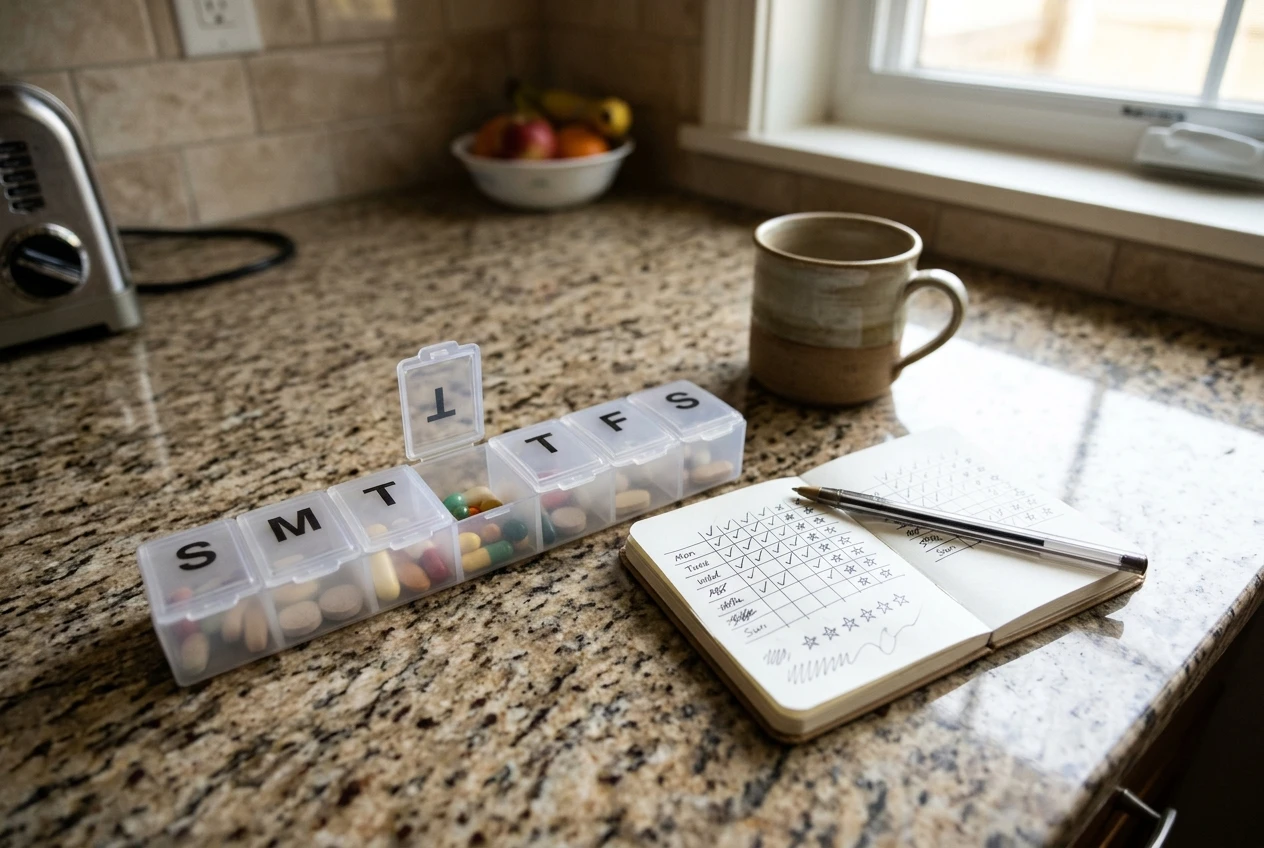
Week 0: baseline, no changes
Spend five to seven days tracking before you take anything. Without a baseline, there is nothing to compare against. Each day, record:
- A 1 to 5 rating for focus at set times, such as late morning and mid-afternoon.
- Minutes of uninterrupted deep work, or number of tasks finished.
- Hours slept and caffeine consumed.
- Any afternoon crash, yes or no.
Keep the method identical throughout. Pick one repeatable measure of output too, such as time to finish a standard weekly task.
Weeks 1 and 2: add one ingredient at a time
Start with the ingredient you expect to matter most, and add the second one at the start of week two. Add a third only if the stack calls for it. This staggering is what lets you attribute effects, which a full stack on day one never can. Stay with the labeled dose and do not raise it because nothing seems to be happening in the first days.
Weeks 3 and 4: hold the full stack constant
Change nothing now, including your routine where possible. This is the period that counts. By now the first-week novelty has worn off, so any improvement that persists is more likely to be real.
Reading the results
Compare weeks three and four against the baseline week. Look for a shift in the averages, not a single good day. A change of half a point on your rating scale, combined with more deep-work minutes, is meaningful. One great Tuesday is not.
Some further points:
- Bacopa is the exception. If you added it, four weeks is too short, so judge it separately after two to three months.
- Placebo is real. If you want to reduce it, have someone else load identical capsules into a pill organizer so you do not know which days contain the active ingredients. This is optional but informative.
- A washout week helps. After week four, pause the stack for a week and keep tracking. If your numbers drop, the stack was doing something. If they do not, you can stop paying for it.
- Stop anything that makes you feel worse. Jitters, stomach upset, poor sleep, or a racing heart are reasons to drop an ingredient, not push through.
A null result is a good outcome. It means you saved money, and it points the effort back toward the foundations.
Who should skip stacking and talk to a clinician first
Natural does not mean harmless. Several ingredients here interact with medications or health conditions, and a pharmacist or doctor is the right person to check them against your situation.
Talk to a clinician before starting if any of these apply:
- You are pregnant, trying to conceive, or breastfeeding.
- You take prescription medication, especially for blood pressure, blood thinning, thyroid conditions, mood, or anxiety. Ashwagandha, rhodiola, and omega-3s all have reasons for caution with certain medications.
- You have kidney or liver conditions. Creatine and some herbal extracts need extra care.
- You have an autoimmune or thyroid condition, since some adaptogens may affect them.
- You have anxiety, high blood pressure, or heart rhythm problems, where caffeine can make things worse.
- You are scheduled for surgery.
- Persistent brain fog is new, severe, or getting worse. This can point to causes such as thyroid problems, anemia, sleep apnea, depression, or nutrient deficiencies, and a stack will not fix those.
If you are young, healthy, sleeping poorly, and eating erratically, skip stacking entirely and address those first. Supplements are the finishing layer, and they work best on a body that is already getting the basics.
Where to go next
If you want the energy side of clarity sorted before you buy anything, read the mitochondria guide next: how to support your mitochondria for steady mental energy.