If you are wondering whether exogenous ketones improve focus and endurance, the short answer is: possibly in narrow situations, and the research is far less consistent than the marketing. Studies are small, often short, and frequently done on trained athletes using products and doses you will not find in a retail tub. This article separates ketones your body makes from ketones you swallow, goes through what the evidence supports for each goal, and looks at what food, fasting and training can do without a supplement.
Endogenous vs. exogenous ketosis: same molecules, very different situations
Ketones are molecules the liver makes from fat when carbohydrate is scarce. The main one in the blood is beta-hydroxybutyrate (BHB). Your brain, heart and muscles can burn it for fuel. Making ketones this way is called endogenous ketosis, meaning it comes from inside you.
Exogenous ketones are ketones you consume: a drink, powder or capsule containing BHB or a compound your body converts to it. The two common forms are ketone salts (BHB bound to minerals such as sodium, potassium, calcium or magnesium) and ketone esters (BHB bound to another compound, usually with a harsh, bitter taste).
The molecule is the same, but the body’s situation is not. When you build ketones through fasting or low-carb eating, three things happen together: insulin is low, stored fat is being released, and your tissues are adapting to burn fat. A ketone drink can raise the BHB number on a meter while none of that has happened. Blood ketones can read the same in both cases while the metabolic state around them is very different.

That difference is why a result from a study on one state cannot be assumed to apply to the other.
What happens in your body when you drink ketones instead of earning them
After a ketone drink, blood BHB typically rises within roughly an hour and falls again over a few hours. Esters generally push levels higher than salts do at normal serving sizes. Your body treats the incoming ketones as available fuel and responds accordingly.
One response matters for anyone hoping to burn body fat. Ketones in the blood signal that fuel is plentiful, and the body tends to make fewer of its own. Research on ketone drinks has also found a modest drop in blood glucose after taking them. So a drink can sit alongside your fat-burning rather than add to it. For weight loss, a ketone drink is not a shortcut. You are supplying a fuel, not triggering the fat-release process that fasting and low-carb eating set off.
The other thing a drink skips is adaptation. People who eat low-carb for a while get better at using fat and ketones as fuel, and that takes days to weeks. A first-time user of a ketone drink has not had that adaptation. The drink is a one-off dose of fuel arriving in a body that is otherwise running on glucose.
Mental performance: what the research suggests and where it runs thin
The theory is reasonable. The brain uses a lot of energy, it can burn ketones, and in conditions where glucose use is impaired, ketones can act as a backup fuel. That is the basis for research into ketones in memory problems and mild cognitive impairment, where small studies have looked at ketone-raising approaches such as medium-chain triglyceride (MCT) oils. Those studies are small, and the results do not carry over automatically to a healthy adult wanting sharper focus at 2 p.m.
For healthy people, the findings on exogenous ketones and thinking are mixed. Some small trials have reported modest changes in certain tasks or in how people felt. Others found nothing. Here is where the evidence runs thin:
- Sample sizes are small. Many trials have a few dozen participants or fewer, which makes chance findings easy.
- Tasks vary. One study measures reaction time, another memory, another mood. A gain in one is not a gain in “focus.”
- Blinding is hard. Ketone esters taste so distinctive that participants often know what they received, and expectation affects how alert people feel.
- Doses and products differ. A result from a lab-grade ester does not tell you what a flavored salt powder will do.
A fair summary: the proposed mechanism is plausible, individual results are inconsistent, and nothing here supports the claim that a ketone drink reliably sharpens a healthy brain. If you want mental energy that holds up through the afternoon, sleep, meal composition and mitochondrial health have far better support. Our guide on how to support your mitochondria for steady mental energy covers that side.
Physical stamina: where ketones might help, where they probably don’t, and who the studies actually tested
Endurance is where exogenous ketones got their reputation. An early, widely reported study in elite cyclists found that a ketone ester drink was linked to a small improvement in a timed ride. The result was exciting enough that sports teams took notice and supplement companies took it further than the data went.

Later studies did not reliably repeat it. Several found no performance benefit in trained athletes, and some found that performance got worse, often alongside stomach trouble. The picture is inconsistent, and the differences between studies matter:
- Who was tested. Most participants were well-trained cyclists, runners or similar athletes. Recreational exercisers, older adults and people new to training are barely represented.
- What form was used. Many positive or neutral results involve ketone esters at specific doses, taken alongside carbohydrate or not depending on the design. Ketone salts have generally been studied less and raise blood ketones less.
- What was measured. A short, hard time trial is not a long hike, a marathon or a weekend of manual work.
- Whether carbohydrates were included. Ketones taken in place of carbs are a different intervention from ketones taken with them.
Where might they help? Possibly in long, hard efforts where fuel supply is a real limit, in people who can tolerate the product. Where do they probably not help? Everyday workouts, short sessions, and training that is not yet consistent. For most people, a dependable sleep schedule, enough total food, and gradually building training volume will improve stamina far more than any powder.
If you train for strength, our look at the recovery tools worth your money is a better use of your budget than most ketone products.
The natural route first: fasting, low-carb eating and training as ways to raise ketones
Your body already knows how to make ketones. Each approach below raises them, and each asks something different of you.

Fasting
Ketone production rises as liver glycogen runs down. For many people that becomes noticeable after about a day without food, though timing varies with your last meal, activity level and body. Overnight fasting raises ketones slightly. Longer fasts raise them more, and also bring hunger, irritability and lower training quality for some people. Fasting is not suitable for everyone, particularly during pregnancy, with a history of disordered eating, or with certain medical conditions or medications.
Low-carb eating
Cutting carbohydrate substantially, commonly to somewhere around 50 grams a day or lower, lets ketone levels rise over days. Expect an adjustment period in which energy and exercise performance can dip before they recover. The cost is mostly dietary: you give up bread, rice, many fruits and most sweets, and you need to plan your meals. The benefit is that you are getting the full metabolic state, not just a number on a meter.
Exercise
Exercise, particularly when done fasted or after a low-carb stretch, nudges ketones up modestly. On its own it is not a strong ketone driver, but it supports the adaptation that makes burning fat for fuel easier. That adaptation is the main aim, and our piece on metabolic flexibility explains how to build it without crash dieting.
MCT oil
MCT oil is a middle option. The liver converts medium-chain fats into ketones quickly, and it raises ketones modestly. It is food-based, but large servings commonly cause stomach upset, so start small.
All of these cost less than a tub of ketone powder, and all of them train the body to produce and use its own fuel.
Side effects, cost and who should skip ketone supplements
Side effects reported with ketone products include nausea, stomach cramps, diarrhea and headaches. Esters are more often associated with a harsh taste and digestive upset. Salts bring a mineral load: a serving can contain a meaningful amount of sodium, potassium, calcium or magnesium, which matters if you watch your blood pressure or have kidney problems. Read the label for the actual amounts, since they vary by product.
On cost, ketone products tend to be expensive per serving, and esters usually more than salts. Check the price per serving, not per tub, and work out what a month of daily use would add up to before you buy.
Some people should talk to a doctor before using exogenous ketones, or skip them:
- People with type 1 diabetes, or anyone with diabetes using insulin or other glucose-lowering drugs. Ketones and diabetic ketoacidosis are a serious concern.
- People taking SGLT2 inhibitors, a class of diabetes medication linked to a risk of ketoacidosis.
- People with kidney, liver or heart conditions.
- Anyone who is pregnant or breastfeeding.
- Anyone with a history of disordered eating.
- Children and teenagers.
Supplement quality is another concern. Products are not tested by regulators the way medications are, so look for independent third-party testing, especially if you compete in drug-tested sport.
How to test a ketone product on yourself without fooling yourself
Expectation is powerful. If you pay for a premium powder and drink it before an important task, you will probably feel something. A simple method reduces that effect.
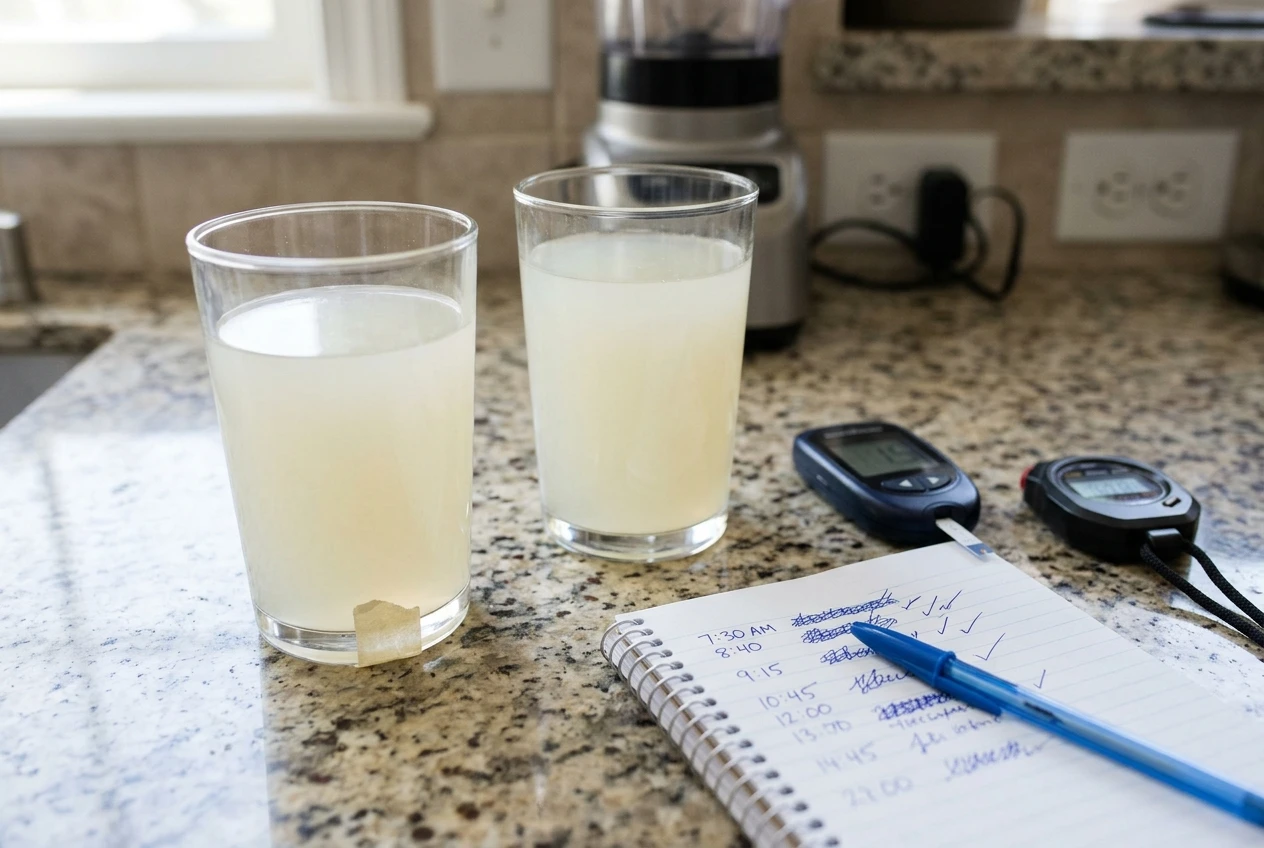
- Pick one outcome. Choose either a mental task (a timed reading or work task, for example) or a physical one (the same route or workout at the same effort). Do not test both at once.
- Take a baseline. Do the task three or more times without the product, at the same time of day, with the same sleep and meal timing as far as you can.
- Change one thing. Add the product at the labeled serving, starting at a lower dose if the product allows it. Keep caffeine, food and training the same.
- Blind it if you can. Ask someone to prepare either the real product or a flavor-matched placebo without telling you which. This is hard with an ester, but works better with a mild powder.
- Record numbers, not feelings. Time, distance, errors, heart rate and a 1 to 10 rating written before you know which drink it was.
- Repeat. One good session proves little. Look for a difference that appears across several attempts and exceeds your normal day-to-day variation.
- Measure ketones if the question matters. A blood ketone meter gives a number. Breath and urine strips are less reliable for this purpose.
If you already track data on yourself, our guide to tracking your own biomarkers offers a sensible way to do it without becoming obsessed with it.
If the numbers show no difference after a fair trial, you have your answer, and you have saved the cost of a monthly subscription.
Questions people ask before buying a ketone drink
Will a ketone drink put me in ketosis?
It will raise the ketones in your blood, which is not quite the same thing. Nutritional ketosis is usually defined by blood BHB at or above about 0.5 mmol/L, and a drink can push you past that number temporarily. The metabolic state of low insulin and fat adaptation is separate and the drink does not create it.
Can I take ketones while eating carbs?
Yes, and many studies have done exactly that. The effects differ from taking them in a fasted or low-carb state, so results from one setup do not transfer neatly to the other.
Are ketone salts as good as esters?
Salts generally raise blood ketones less than esters at typical serving sizes and carry a mineral load. Most of the performance research has used esters, so findings about them should not be assumed to apply to salts.
Do they help with weight loss?
The evidence does not support that. A drink supplies ketones, but it does not make your body release more of its own stored fat, and it may reduce your own ketone production. Food choices, total energy intake and activity decide fat loss.
Do they work like a nootropic?
Some people compare them to cognitive supplements, but the evidence for healthy adults is weaker and less consistent. For a more thorough look at that category, see our guide to nootropic stacks that still work after week two.
What should I try first?
Sleep, regular meals with enough protein, consistent training and, if you are interested and it suits your health, a gradual move toward lower-carb eating. These cost little and have far stronger evidence. A ketone product is something to consider afterward, as a test with a clear goal.
Read next: Metabolic Flexibility Explained, to see how teaching your body to burn fat for fuel fits alongside any ketone strategy.