
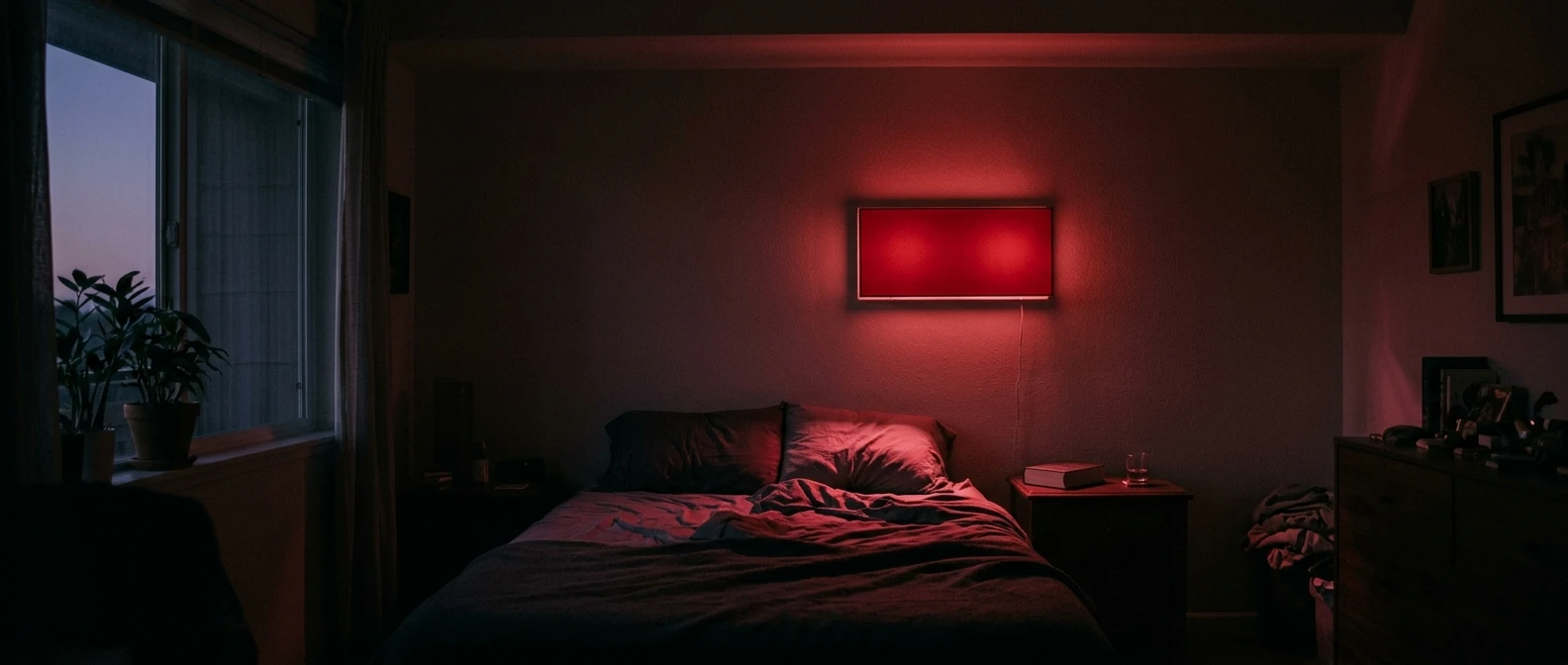
If you are shopping for the best red light therapy panels for sleep and recovery, most of what you read is written to sell you the biggest, most expensive one. The more useful question is which numbers on a spec sheet tell you something, which ones are decoration, and which claims the human evidence actually backs. A panel that is honest about its output at a stated distance and flat in its light delivery will do more for you than one with twelve wavelengths and a dramatic name.
This guide covers panels only. It explains how to read the specs, how to check for flicker, which wavelengths matter, how to compare panels by cost per usable area, and how to fit a panel into an evening. For the wider set of recovery options, the recovery tools roundup covers what else is worth your money.
What a Light Panel Can and Can’t Do for Sleep and Recovery
Red and near-infrared light applied to the skin is studied under the name photobomodulation. The research on recovery is the more developed of the two areas. Reviews of exercise studies suggest that light applied before or after training may reduce muscle soreness and help maintain performance in some trials. The results vary a lot, and the variation tracks the dose, the timing and the device used. That variation is the reason spec sheets matter: two panels sold for the same purpose can deliver very different amounts of light.
The sleep evidence is thinner. There are small trials, some in athletes, reporting better self-rated sleep quality after a period of regular red light sessions. They are short and small, and they do not tell you which wavelengths, doses or session times produced the effect. Treat sleep as a plausible, modest benefit that is still being tested, not an established one.
A panel does not do several things that marketing hints at:
- It does not replace a consistent sleep schedule, a dark bedroom or a cool room.
- It does not treat sleep apnea, chronic insomnia or pain conditions.
- It does not “detox” anything or boost melatonin by a measurable amount you should plan around.
- It does not work faster the more you spend.
Buy a panel as one low-effort addition to routines that already work. If the rest of your evening is chaotic, the panel will not rescue it.
How to Read a Spec Sheet: Irradiance, Distance, and the Numbers Brands Leave Out
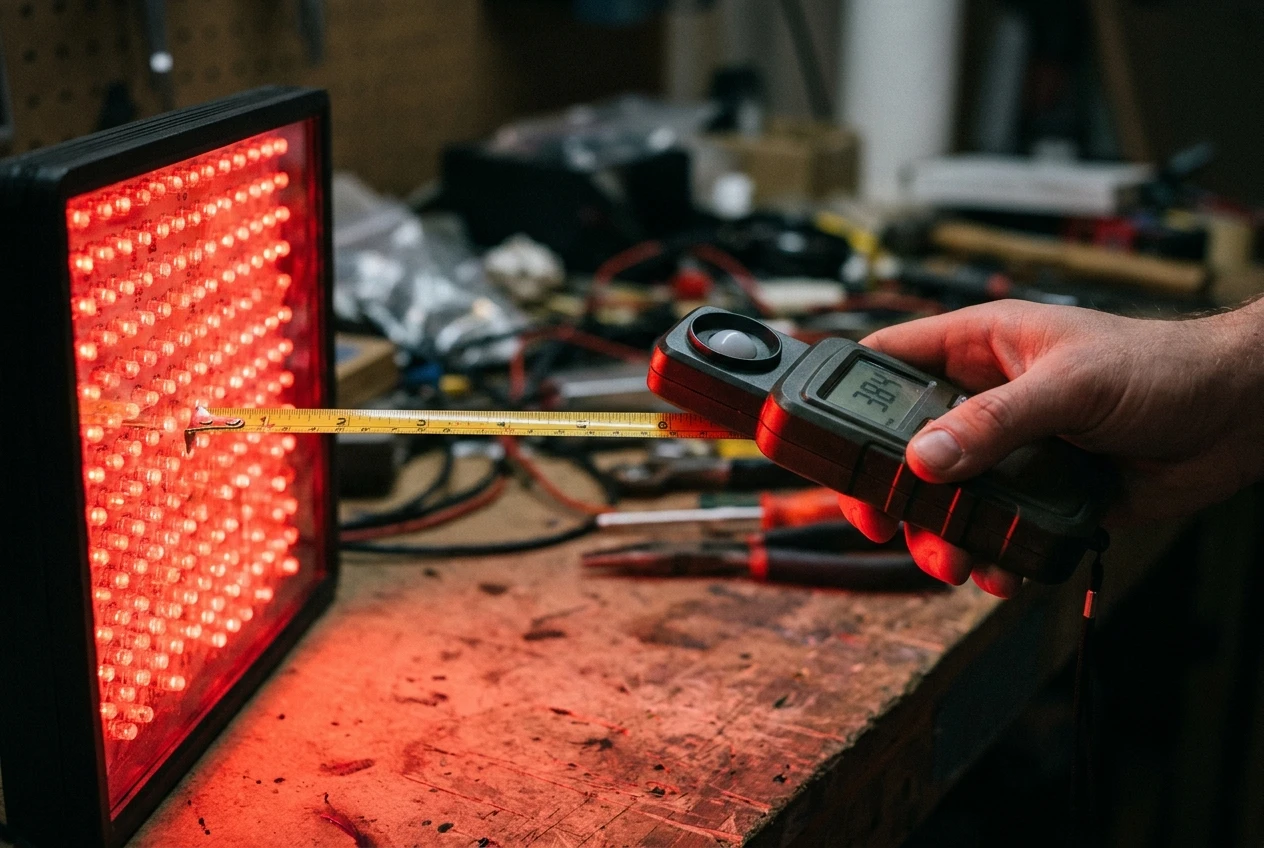
Irradiance is the amount of light power landing on each square centimeter of skin, written in milliwatts per square centimeter (mW/cm²). It is the most important number on the page, and it is meaningless without a distance. A panel that delivers a high figure at the surface of the glass may deliver much less at the 15 or 30 centimeters you will actually sit from it. Light output falls as you move away, and the spec should say where the measurement was taken.
Dose is what your skin receives over a session, in joules per square centimeter (J/cm²). The arithmetic is simple: irradiance in mW/cm² times seconds, divided by 1000. As an illustration, a panel delivering 20 mW/cm² at your sitting distance for 10 minutes (600 seconds) gives 12 J/cm². Use this to compare panels fairly, because a lower-irradiance panel can reach the same dose with a longer session.
Watch for these common gaps and soft spots on spec sheets:
- Watts of electrical input. A “300 W” panel draws 300 watts from the wall. That is not the light output, and efficiency differs between designs.
- No stated distance. If the irradiance figure has no distance next to it, ask the seller or assume the most flattering one.
- Peak versus average. The hottest spot on a panel can read much higher than the average across the treatment area. Ask whether the figure is a center reading or an average.
- Who measured it. A figure from a calibrated solar power meter or spectrometer, ideally from a third party, is worth more than “tested in our lab.” Be cautious about a figure with no method behind it.
- Output when warm. LEDs often put out less light once they heat up. A figure taken in the first few seconds can overstate what you get ten minutes in.
- Uniformity. A panel with a bright center and weak edges treats less skin effectively than its size suggests.
Practical details also matter for evening use. Fan noise is a real issue if you plan to run a panel in a quiet room before bed. Look for a built-in timer, a stable stand or a door mount, a stated warranty and a return window long enough to test it.
Flicker and EMF: How to Check a Panel Is Flicker-Free Before You Buy
Many LED panels dim or regulate power by switching the LEDs on and off very fast, called pulse width modulation. If the switching is slow enough or the dips are deep enough, the light flickers even when your eye cannot see it. People who are sensitive to flicker report headaches or eye strain, and a light you plan to use in the evening, close to your face, is a poor place to find out you are one of them.
There are three ways to check, from cheapest to most reliable:
- Ask for a flicker report. A reputable maker can tell you the flicker percentage and frequency in constant mode, and ideally gives you a test report. A vague “flicker-free technology” claim with no numbers tells you nothing.
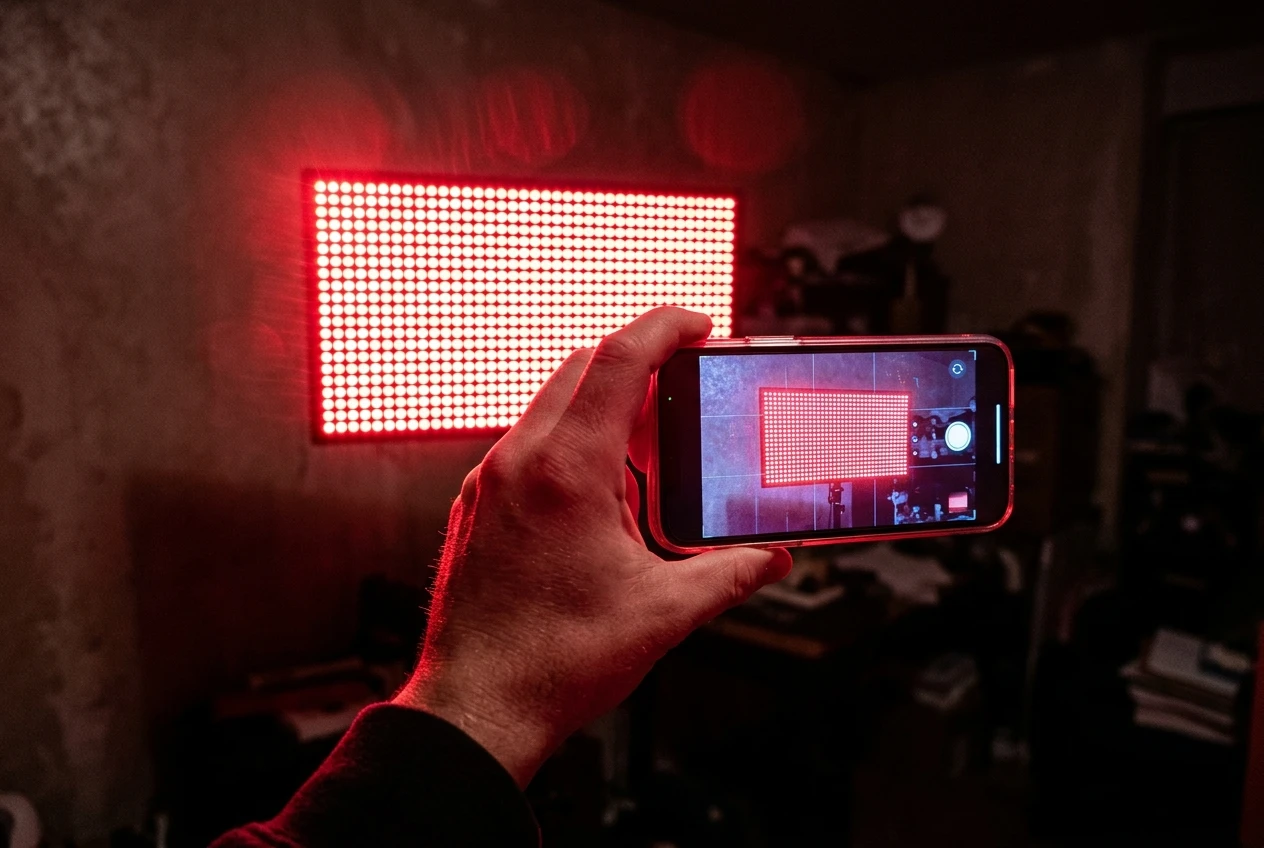
- Do a phone test. In a darkened room, point your phone camera at the lit panel in slow-motion video (120 or 240 frames per second) and watch for moving bands, pulsing or shimmer. Steady, uniform light on screen is a good sign. This is a rough screen, not a lab test, but it catches obvious offenders, and you can do it in the store or in the first days of a return window.
- Look for independent testing. Some reviewers use flicker meters and publish waveforms. A third-party reading beats a manufacturer’s own statement.
Some panels offer a pulsed mode as a deliberate setting. That is fine if you chose it. The constant mode should be flat, and you should be able to tell the two apart.
EMF is the other claim worth a question. LED drivers and power supplies produce electric and magnetic fields, and panels used at close range are near your body. The evidence that fields at this level cause harm is not strong, so this is a precaution, not an alarm. Still, a maker that has measured and published field strength at a stated distance is showing you how much care went into the build. If a brand advertises “low EMF” and gives no number or distance, you are looking at a slogan.
Wavelengths That Matter: Red, Near-Infrared, and Why More Colors Isn’t Always Better
Most of the research uses two bands. Red light, roughly 630 to 670 nanometers, is absorbed closer to the surface and is visible as a deep red glow. Near-infrared, roughly 810 to 850 nanometers, penetrates deeper and is invisible. A panel combining something like 660 nm and 850 nm covers both bands, and that pairing is common for good reason: it matches much of what has been studied.
Two points are worth keeping in mind:
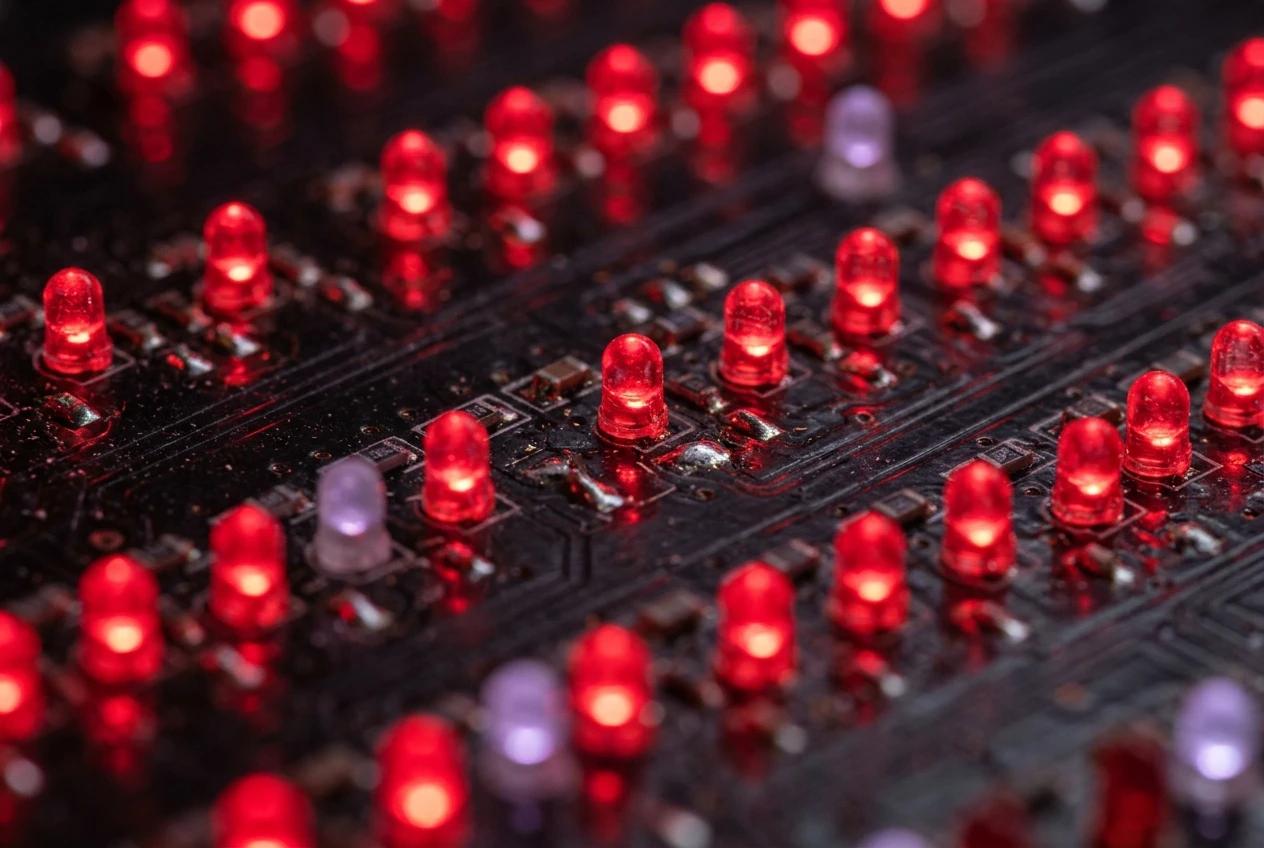
- The usual wavelength labels are nominal. LEDs have a tolerance. A panel labeled 660 nm may peak a few nanometers either way, which is acceptable. A large gap between claim and measurement is not.
- Output per wavelength matters more than the count. Ask what irradiance each band delivers. A panel can advertise 850 nm and give you a trace of it.
Panels with five or six colors, including blue, green, yellow and amber, are usually a way to charge more. Each extra wavelength takes up space on the board that could have gone to red and near-infrared output. The human evidence for those additional bands, in the context of sleep and recovery, is much thinner. Blue is also a poor choice for the evening, since blue-rich light late in the day is associated with later sleep timing. If a panel has switchable bands, you can turn blue off, but then you have paid for something you will not use.
Visible red at high brightness is still bright. For evening use, a panel that lets you turn the red channel down, or run near-infrared only, gives you more control.
The Panels Compared: Price, Power, Size and Build Side by Side
Individual models change their specs, prices and revisions often, and manufacturer claims shift between batches. So rather than hand you a ranking of brand names that may be stale by the time you read it, here is a comparison by panel class, followed by a way to score any specific model you are considering.
Class Typical coverage Best for Main trade-off Compact or desktop panel One body area at a time, such as shoulders, a knee or the face Targeted recovery, small spaces, lower budgets Slow if you want to cover multiple areas, and distance matters a lot Mid-size panel Torso or both legs at close range Most home users, sitting or standing sessions Needs a stand or mount, and the price rises quickly with size Large or full-body panel (single or paired) Most of the body from one position Shared use, quick sessions, whole-body routines Highest cost, more power draw, takes up wall or floor space
To compare specific models inside a class, score them on these points:
- Irradiance at your actual distance, stated by the maker or measured independently.
- Usable treatment area. This is the area where output stays near the stated figure at your distance, which is usually smaller than the full panel face.
- Cost per usable treatment area. Divide the price by usable area. If one panel costs twice as much but has three times the usable area at the same irradiance, it is the cheaper way to treat a body. A cheap panel with a small usable area is expensive per session.
- Flicker and EMF documentation. A published report counts for more than a claim.
- Wavelength mix and per-band output. Prefer red plus near-infrared with numbers behind both.
- Build. Check fan noise, timer, heat management, mount options, warranty length and return policy.
- Seller transparency. If a brand will not tell you the measurement distance, that is information.
Run every shortlisted panel through that list. The one that ends up on top is often not the most expensive and rarely the one with the most colors.
Which Panel Fits Which Person: The Sleeper, the Lifter, and the Budget-Conscious
The sleeper. Your priorities are quiet operation, a flat constant mode and control over brightness. A mid-size panel with a low-noise fan or fanless design and a documented flicker report suits an evening wind-down better than a high-output unit that you have to run on its dimmest setting. Near-infrared-only or red-dimming options are useful because you can keep the room dark. Skip anything with a mandatory blue channel.
The lifter. You want coverage of big muscle groups and enough irradiance to deliver a meaningful dose in a short session before or after training. A mid-size or large panel is the practical choice, because moving a compact unit across the quads, back and shoulders takes longer than the session itself. Durability, a stable stand and a long warranty matter more than they do for a casual user. If your recovery is built on a few other tools already, the cold plunge tub comparison covers the other major home investment.
The budget-conscious. Buy the smallest panel whose documented output at your distance is respectable, not the cheapest one on the page. A compact panel with honest numbers will do more than a large panel with unverified ones, and you can treat one area at a time. Put the money into verified irradiance and flicker testing before you put it into size or extra colors. Check the return window, because buying a panel you can send back is a cheap way to test your own flicker sensitivity and noise tolerance.
Using a Panel Properly: Timing, Distance, and Sessions That Fit Your Evening
Start with the distance the manufacturer’s irradiance figure was measured at, since that is the only distance for which you have a number. Move closer and the dose rises, move farther and it drops, and your session time should follow. If a manufacturer recommends a distance and session length, use that as the starting point, and keep notes so you know what you did.
Some practical guidelines:
- Session length. Short sessions, often in the range of several minutes to around ten or fifteen, are typical in the published work, but the right length depends on your panel’s irradiance. Use the dose arithmetic above, and increase slowly if you want to.
- Frequency. Most studies run multiple sessions per week over several weeks. A few sessions will not tell you much. A consistent schedule for a month will.
- Evening timing. The research does not settle the best time for sleep benefits. A reasonable approach is to run your session during the early part of your wind-down, in dim light, then keep the rest of the evening low-stimulus. Track how you sleep over several weeks and adjust from there. If a session late in the evening leaves you feeling more alert, move it earlier.
- For recovery. Some studies apply light before exercise and others after. Choose one and stay with it long enough to judge.
- Eyes. Do not stare into a bright panel. Close your eyes or use the eye protection that comes with higher-output units.
- Skin. Bare skin works best, because clothing blocks light. Stop if you notice irritation or unusual heat.
A short note on safety: people who are pregnant, have an active medical condition, take photosensitizing medication or have eye conditions should speak to a doctor before starting. A panel is a consumer device and not a medical treatment, so it does not substitute for care.
Where a Panel Fits Next to Cold Exposure and a Circadian Routine
A panel is the least disruptive of the common recovery tools. It takes no setup, it has no upkeep beyond cleaning and it can run while you read. That makes it easy to combine with other habits, but the combinations are not all equal.
On the cold side, timing matters. Some research suggests that cold water immersion right after strength training can blunt part of the muscle-building response. If your goal is muscle growth, separating your cold sessions from your hardest lifting is a sensible approach, and you can place a red light session in the gap. If you are exploring cold more broadly, the guide to top cold exposure techniques covers options that do not need a tub.
On the sleep side, light timing is the bigger lever, and a panel cannot compensate for the rest of your evening light. Morning daylight, dimmer evening lighting and a consistent wake time have more behind them than any device. The piece on how to reset your circadian rhythm naturally lays out that routine, and a panel works best as an addition to it. Use the panel under the same conditions you are trying to build: low ambient light, screens off or dimmed, and a regular bedtime.
If you decide to buy, check the current price and independent spec details for your top pick, and verify the manufacturer’s irradiance and flicker testing before you pay.